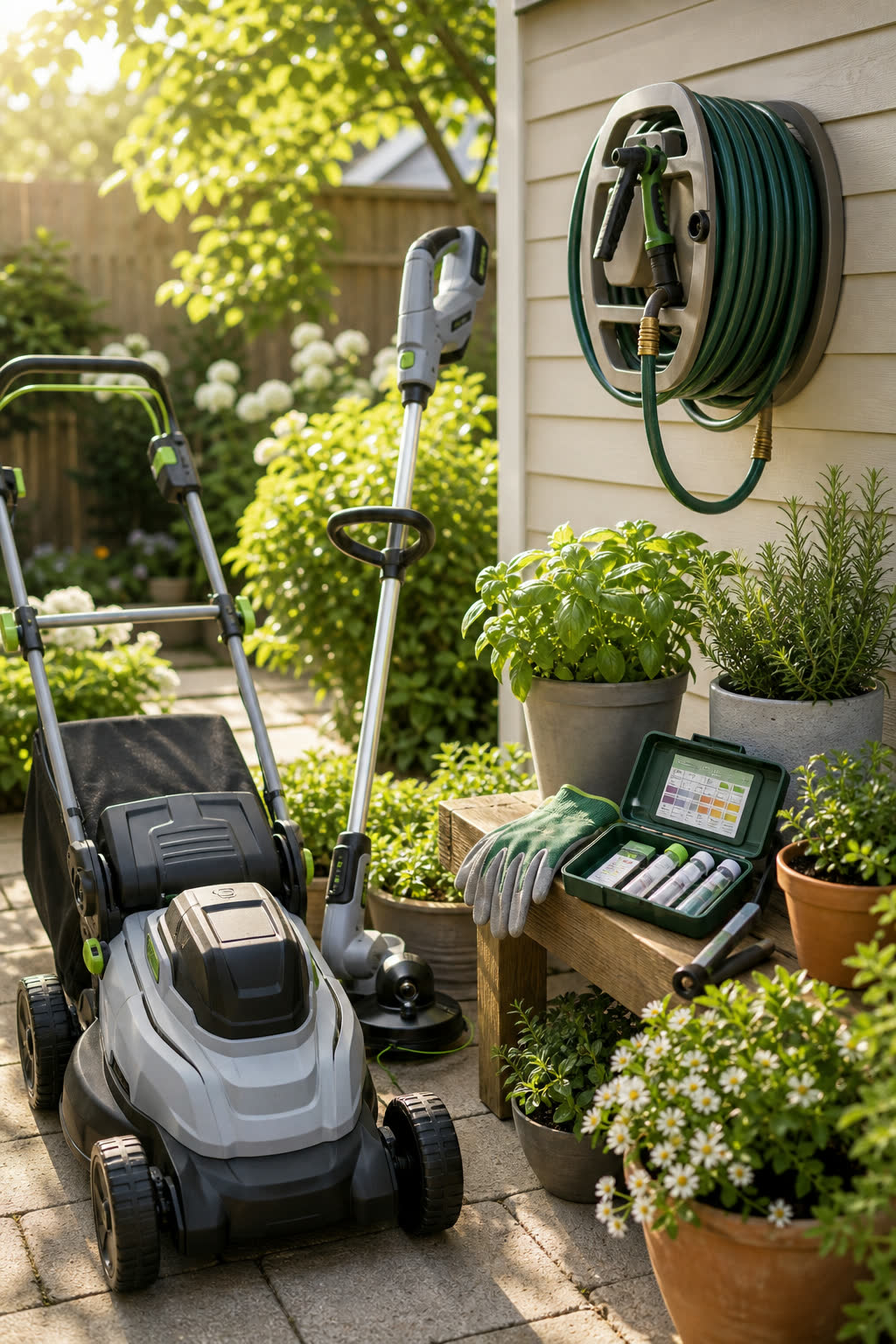
The direct answer: during your first month, do not try to restore, redesign, fertilize, prune, and equip the whole yard. First address an active hazard or leak. Then photograph the yard, record sun and water, identify what is already growing, and maintain only the parts needed for safe daily use.
A new yard hides decisions underground and across seasons. Bulbs may be dormant. A dry-looking corner may collect roof runoff in the next storm. A shrub that seems overgrown may be about to flower on old wood. Waiting is not neglect when the area is safe; it is how you avoid paying to undo a rushed cut, treatment, or purchase.


Day 1: make a safety and access map
Walk the yard without tools. Take one wide photo from every door and one close photo of anything uncertain. Mark the following on a rough sketch:
- Urgent stops: downed or low wires, hanging limbs, unstable steps, open holes, broken glass, active irrigation leaks, standing water against the house, and gates that do not latch.
- Normal routes: doors, trash path, meter access, pet route, hose faucet, outdoor outlet, mower route, and the narrowest gate or side passage.
- Water movement: downspouts, slopes, low spots, puddles after rain, sprinkler overspray, and soil that stays wet a day later.
- Existing plants: photograph the whole plant, leaf, stem, flower or fruit, and its location. Label it “unknown” instead of guessing.
Do not dig merely to investigate a buried line. In the United States, use the local 811 service before a project that breaks ground. If a tree, retaining wall, electrical condition, drainage problem, or chemical exposure looks unsafe, stop and use the relevant qualified local professional.
Week 1: learn the yard before changing it
Check the same four places in the morning, around midday, and late afternoon. You are not making a perfect landscape survey. You are collecting enough evidence to avoid the most expensive beginner mistakes.
| Record | Simple method | Decision it changes | Do not assume |
|---|---|---|---|
| Sun | Photo the same bed three times | Plant fit, watering, seating, privacy | One sunny hour means full sun |
| Drainage | Photo during rain and 24 hours later | Planting, storage, patio and runoff work | A dry-day inspection shows the low spots |
| Mowable area | Measure grass only, not the whole lot | Mower type, deck width, runtime | A small property needs a large mower |
| Routes | Measure the narrowest gate and turn | Tool width, storage and transport | A product that fits the lawn fits the route |
| Plants | Label photos by location and date | Pruning, removal and watering timing | An unknown plant is a weed |
If a plant is healthy enough to wait, let it show more identifying features. If it is declining, record the root-zone moisture, recent weather, light, trunk or stem damage, and nearby changes before adding water, fertilizer, or pesticide. A symptom alone does not identify the cause.
Weeks 2–4: build the smallest maintenance loop
Your first routine needs only four checks. The schedule changes by climate, grass type, season, soil, and plant, so use observation rather than a universal “every Saturday” rule.
- Walk the safety route. Clear the path, check gates, and look for fresh storm damage or leaks.
- Check before watering. Look below the surface in the actual root zone. Water need differs between lawn, containers, new plants, and established beds. Pooling water or persistently wet soil is a reason to stop, not add another cycle.
- Mow by grass height. Remove no more than about one-third of the grass blade in one mowing. If the lawn escaped you, raise the deck and reduce the height over more than one session.
- Contain one fast problem. Bag broken glass, stop a seeding weed patch, move a trip hazard, or schedule the repair. Do not turn one visible problem into a full-yard chemical treatment.
Keep a one-page log with the date, weather, task, time spent, and what changed. After four weeks, the repeated jobs become visible. Those repetitions—not a generic starter bundle—tell you what deserves storage space and money.
How much time can you actually give this yard?
Count the whole task, not just minutes with a tool running. Carrying a mower out, moving furniture, uncoiling a hose, cleaning equipment, and returning it to storage are part of the job. There is no reliable universal number of minutes for a “small yard.” An open lawn and a patio full of containers can need very different routines.
In the overwhelmed-beginner discussion, the new owner wanted to know the minimum care needed while learning what the plants were. The useful distinction is between necessary care and optional improvement—not between a tidy yard and an untidy one. This worksheet turns that distinction into a plan you can fit around your week.
Measure two weeks before adding another project
- Write a realistic available block. Use the minutes you can spare after work, travel, and other commitments. Separate short checks from a longer block for mowing or cleanup. Do not fill every spare minute: weather and repairs can change the week.
- Time setup, work, and cleanup separately. Start when you begin collecting the equipment; stop when it is safely stored. Record actual minutes rather than the advertised runtime of a battery.
- Count how often the task really happened. Note the weather and why the task was needed. A moisture check is not a watering session. Record watering separately when it is required; do not create seven watering sessions because the plan contains seven checks.
- Repeat next week. Compare the same task with the same scope. Mark an unusual storm cleanup or a one-off repair instead of treating it as an ordinary weekly job. Two weeks are a starting sample, not a full-season forecast.
Whole-task time card
Use one card per week. The inputs are local notes, not a submitted form. Copy your entries before leaving; they are not saved by this site or sent to analytics. For each task, write sessions × (setup + work + cleanup) in minutes.
Worked example—not a care schedule
A hypothetical week has 120 available minutes. One 30-minute mowing session, seven 5-minute plant checks, and two 15-minute tidy-ups total 30 + 35 + 30 = 95 minutes. That leaves 25 minutes before other work or surprises. These are invented arithmetic inputs, not measured averages or recommended frequencies. If the plants also need watering, its full setup-to-storage time must be added.
What to change when necessary care exceeds your budget
First check whether the list contains optional appearance work disguised as urgent maintenance. Delay moving a border, rearranging pots, or shopping for new plants. Do not delay an active safety problem or let the worksheet substitute for diagnosis of a declining plant. If essential work still does not fit, arrange help or plan a simpler layout rather than pretending a new tool removes the workload.
If setup and cleanup take longer than the work, fix that bottleneck first. A reachable hose hanger may matter more than a larger reel; accessible hand-tool storage may matter more than a bigger box. If the active mowing portion dominates, compare an appropriate mower only after measuring the grass, gates, slope, handling, and storage. A claimed faster cutting speed is not evidence of a shorter complete job at your home.
For a borrow-versus-buy test, repeat the same safe task with the borrowed tool and include collection, cleaning, charging, and return time. Do not calculate a payback from one unusually easy session. A seasonal task may justify renting even if borrowing takes longer. Keep the three buying roles below as options, not a required kit.
Know when this card stops being representative
- A dry week becomes a hot spell: recheck actual plant need. EPA WaterSense recommends adapting irrigation to weather and landscape conditions; a time budget is not permission to skip necessary care or water wet soil.
- Leaves fall or growth accelerates: make a fresh seasonal card. Do not multiply a quiet-week sample by 52 and call it an annual estimate.
- A tool saves work but adds handling: compare the complete cycle again. Include its dry storage space and the effort of moving it through the narrowest route.
- The plan never fits: reduce optional scope, get help, or evaluate a lower-maintenance area using the flower-bed maintenance guide. Changing plants or ground cover still has establishment work.
Use the log to choose repair, borrow, buy, or wait
At the end of each week, put every yard problem into one of four boxes. This keeps a first-time homeowner from turning one stressful Saturday into a pile of duplicate tools.
| Box | Use it when | Example | Do not do this |
|---|---|---|---|
| Repair first | The problem affects safety, water near the house, access, utilities, or a structure. | Blocked drain, loose step, low limb over a walkway, or active irrigation leak. | Hide it with mulch, a planter, furniture, or a storage box. |
| Borrow or rent | The job is real but may be seasonal, one-time, or too bulky for permanent storage. | Extra rake for one leaf weekend, pressure washer, aerator, or heavy cleanup tool. | Buy a large tool before proving it returns next month. |
| Buy one role | The same job repeats, you measured the route, and the item has a dry home. | A compact mower for measured grass, a hose hanger for the same tangled route, or a deck box for hand tools. | Buy a universal starter kit with tools you have not used. |
| Wait and identify | The plant, pest, water source, soil condition, or local rule is still unclear. | Unknown shrub, wet corner after a storm, weed patch near wanted plants, or soil amendment decision. | Spray, fertilize, prune hard, dig, or remove everything because it looks messy. |
The first tool should solve the repeated bottleneck
A starter tool list is useful only after the yard gives you a job. If the first repeated job is grass, measure mowable square footage, gate width, slope, dry storage, and total setup time. If the repeated job is watering, trace faucet to bed and check whether the hose crosses a door or steps. If the repeated job is clutter, measure the longest tool and the opening space for any box or cabinet. If the repeated job is hauling, measure the loaded route before comparing carts.
Do not buy a bundle because it looks complete. Small yards punish storage mistakes. One tool that fits the route and solves a weekly problem is better than six tools that live in the way.
What to delay until you have evidence
- Large pruning: wait until you identify the plant, its health, and when it flowers. Incorrect timing can remove the next bloom or expose a larger problem.
- Fertilizer and lime: use a laboratory soil test and local interpretation when the decision matters. A small retail color test is not a complete maintenance plan.
- Broad herbicide or homemade mixtures: identify the target, use site, nearby plants, and label requirements first. “Natural” does not mean harmless to soil, pets, people, or wanted plants.
- Permanent beds and hardscape: observe runoff, sun, snow or leaf routes, utilities, doors, and maintenance access before changing grade or digging.
- A matching battery platform: confirm that you actually need more than one powered tool. A bundle saves little if the second tool is heavy, unnecessary, or hard to store.
Three purchases that can earn their space
These are not a required starter kit. Compare one only after the same job appears twice and the complete route, storage footprint, and action box point to buying.
Recurring grass route
Compact electric mower
Compare this only when you have a measured mowable area and a dry route from storage to grass. Skip it for a tiny patch that a manual reel mower or occasional service can handle more simply.
Tangled-water-route
Hose reel or hose hanger
Compare this when the hose repeatedly blocks a door or path. Measure faucet-to-bed distance, the reel footprint, leader-hose reach, drainage, and winter storage before choosing wall-mounted or freestanding.
Small-tool storage route
Compact weather-resistant deck box
Compare this only for gloves, nozzles, hand tools, and small supplies that already lack a dry home. Skip it when long-handled tools are the real problem or when the box would narrow an exit.
Common first-month failures
- Buying for lot size instead of the job. Measure mowable grass, hose route, narrow gates, storage, slope, and setup time separately.
- Watering every plant together. Containers, lawn, new transplants, established shrubs, and shaded beds do not share one root zone or schedule.
- Removing every unknown plant. Photograph and label it. Remove immediately only when the hazard or identification is sufficiently clear.
- Starting five projects that depend on each other. Finish one safe route or recurring task. Put dependent projects in a later list.
- Copying a national calendar. Use local Extension guidance for climate, grass species, pruning windows, pests, and soil interpretation.
- Treating visual neatness as plant health. A freshly cut or sprayed yard can still have compacted soil, poor drainage, damaged roots, or a mismatched plant.
Your first-month handoff
At day 30, keep three lists: must maintain, needs identification or local advice, and optional improvement. Choose one optional project only after it fits the sun, water, route, storage, permission, and maintenance time you observed.
For the mowing decision, use the reel, corded, and battery mower comparison. For a hose that creates weekly friction, continue with the hose storage route guide. For small tools and long-handled tools, compare the actual storage jobs in the outdoor tool storage guide. If standing water keeps returning, use the small-yard standing water route check before buying drainage parts. If the whole yard still feels like one project, use the measure-first garden tools guide before adding equipment.
Sources and limits
The maintenance boundaries were checked against the University of Minnesota Extension lawn-care calendar, Oregon State University Extension practical lawn-care guide, Colorado State University Extension lawn-care basics, University of Georgia Extension landscape basics for new homeowners, EPA WaterSense watering guidance, and 811 Before You Dig. Community questions that exposed the missing decisions included Gardening & Landscaping Stack Exchange discussions about an overwhelmed owner of an established garden, identifying unknown plants after buying a house, and a new house with a dirt yard and ideas in mind, plus Permies discussions about prioritizing when every task seems connected, garden-task disorganization, and balancing watering, mulch, fencing, time, and money. Community cases identify real questions and language; they are not universal safety, plant-health, chemical, or scheduling instructions.